Air quality in beautiful places became bad and what I learned
How I discovered that beautiful places like Cyprus and Tbilisi have bad air quality, and what I learned about AQI, air pollution, and protecting myself.
Current bad air quality in Tbilisi
Today, November 30, 2025, the air quality in Tbilisi, the city in Georgia where I currently live, has an AQI of 105. Yesterday evening the AQI was 171.
It’s poor quality level. Good level is in the range between 0 and 50. So, the air in Tbilisi is bad. Recent reports show that Georgia has been experiencing unusually high air pollution levels, with elevated concentrations of fine dust particles (PM10 and PM2.5) affecting Tbilisi and other cities.
Tbilisi is a beautiful South Caucasian ancient city. River, gorgeous mountains, trees, rich local food. There are no industrial things like copper and nickel factories in Norilsk, where I grew up.
In the Soviet Union period, Georgia was the most popular destination for health recreation for people from all over the USSR. There is supposed to be very good air, so good to heal industrial-polluted lungs of Soviet workers.
What went wrong?
A climate change effect on Tbilisi air quality
Increased global temperature led to increased local temperature, melted ice in mountains, dried ground.
The Sahara desert has become wider than 50 years ago, and its sand reaches the Caucasian mountains! Every dust storm in the Sahara has an effect on Georgia and Tbilisi itself.
Poor city planning trapped air pollution in Tbilisi
Over the past decade, the city has been actively constructing buildings without a master plan.
Green spaces that have been here for about a century are being cut down, and restoring them will be difficult. Buildings are being constructed without regard for wind flow, and the city is currently designed in such a way that polluted air, especially in winter, when warm air from the city cannot rise high due to the cold air above, is trapped and does not leave the streets.
Moreover, there is a lot of open land where roads or greenery should be. And this soil covers all the city’s surfaces with dark gray dust and settles in the lungs of the city’s residents.
How my awareness began in Cyprus
I moved to Tbilisi from Limassol, Cyprus, in 2024, where I settled in spring 2022, having moved there from St. Petersburg, Russia.
In Limassol on my first spring I was surprised by dust storms that looked like in the Interstellar film.
Sahara’s dust storms are a common thing in Cyprus, but it’s supposed to be like not more than 2 weeks per year, during the beginning of spring. But in 2022, storms did not stop. Dust was everywhere, outside and inside of buildings. Our gorgeous inner pool in the villa became muddy.
I was scared as fuck. And I’m from Norilsk, the most polluted northern city in the world! I thought that nothing could scare me. For the first time in my life I bought an air purifier. At least my room was cleaned from dust.
And I started to take photos of the Cypriot sky. Every day by paying attention to the sky, I began to discern with just one glance the level of air pollution. This practice formed the basis of my first art works, which were featured in my exhibition “Do you love the color of the sky?” in Limassol and my installation on the group exhibition “RE:SOURCE”.
Now I want to exhibit in Tbilisi too, so I built a map of the city’s art spaces and set out to explore the local scene.
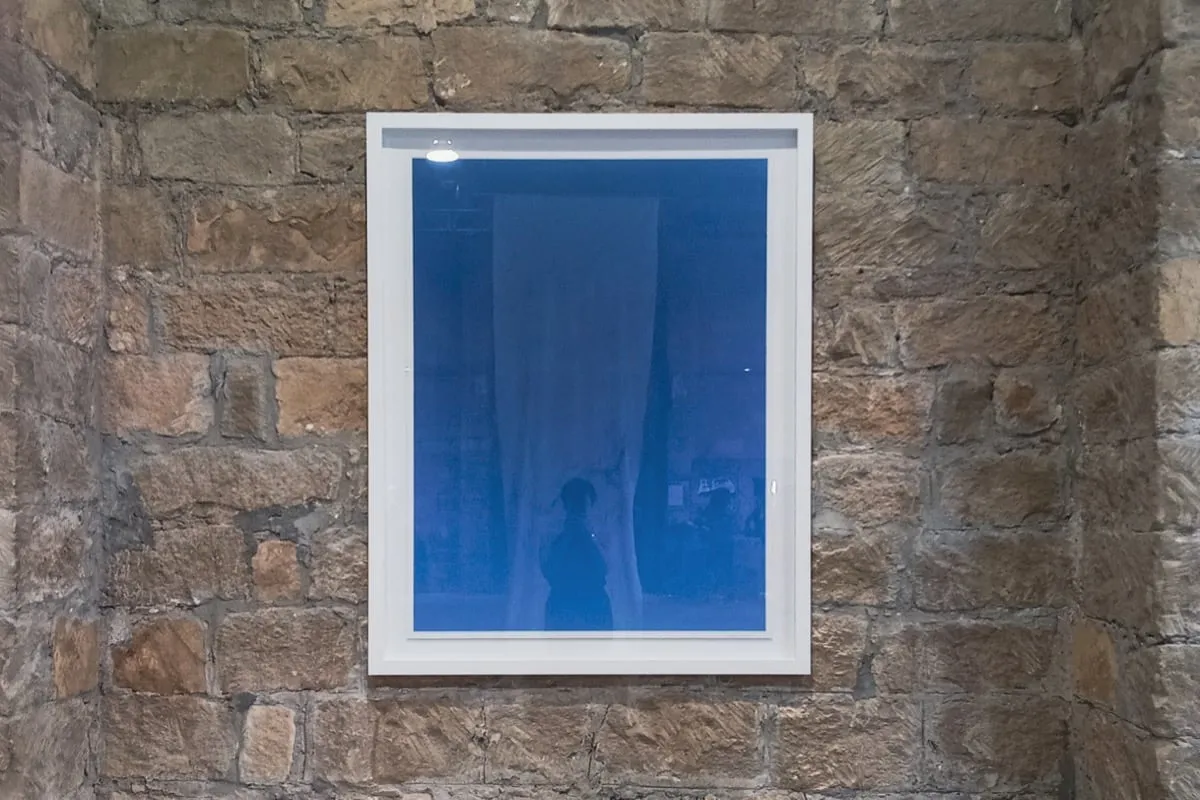
My installation from “RE:SOURCE” group exhibition, 17-21 May 2024, Limassol, Cyprus. “The Blue” artwork. I searched for months for a clear sky, but even this one contains dust particles.
Meeting AQI and learning about air quality
And I started to learn about air quality. It turns out that the dusty horror I witnessed with my own eyes has a recognized designation - the Air Quality Index (AQI).
AQI is a standardized scale used worldwide to communicate how polluted the air currently is or how polluted it is forecast to become. The index typically ranges from 0 to 500, with higher values indicating greater levels of air pollution and greater health concerns.
AQI values are divided into categories:
- 0-50 (Good): Air quality is satisfactory and poses little or no risk.
- 51-100 (Moderate): Acceptable for most people, but sensitive individuals may experience minor breathing discomfort.
- 101-150 (Unhealthy for sensitive groups): Members of sensitive groups may experience health effects. General public is less likely to be affected.
- 151-200 (Unhealthy): Everyone may begin to experience health effects. Sensitive groups may experience more serious effects.
- 201-300 (Very unhealthy): Health alert: everyone may experience more serious health effects.
- 301-500+ (Hazardous): Health warning of emergency conditions. The entire population is likely to be affected.
In Cyprus some days AQI was higher than 300! I was unlucky to have such a bad day while hosting my first art exhibition in Limassol. Health experts warned that these high dust levels were a serious public health issue. I had almost zero visitors those days, and I don’t blame people. It was just really unlucky timing.
Understanding air quality metrics
The air quality index takes into account multiple pollutants and reports the highest value among them, giving you a single number that represents the overall air quality risk.
There are key pollutants that are measured and reported:
-
PM2.5 (Particulate Matter 2.5): Fine particles smaller than 2.5 micrometers that can penetrate deep into the lungs and even enter the bloodstream. These are among the most dangerous pollutants because they can carry toxic substances and cause serious health problems.
-
PM10 (Particulate Matter 10): Larger particles up to 10 micrometers that can irritate the eyes, nose, and throat. While less dangerous than PM 2.5, they still pose health risks, especially for people with respiratory conditions.
-
CO (Carbon Monoxide): A colorless, odorless gas produced by incomplete combustion. High levels can cause headaches, dizziness, and in extreme cases, can be fatal.
-
SO2 (Sulfur Dioxide): A gas produced by burning fossil fuels, especially coal. It can cause respiratory problems and contribute to acid rain.
-
NO2 (Nitrogen Dioxide): A reddish-brown gas produced by vehicle emissions and industrial processes. It can irritate the respiratory system and contribute to the formation of other harmful pollutants.
-
O3 (Ozone): While ozone in the upper atmosphere protects us from UV radiation, ground-level ozone is a harmful pollutant formed by chemical reactions between sunlight and pollutants. It can cause breathing problems and worsen asthma.
In Cyprus and Georgia the most common pollutants are PM2.5 and PM10. Near roads and industrial areas the most common pollutants are CO, SO2, NO2, O3. They could be measured by sensors if these sensors are placed in the right places. In Cyprus a lot of sensors are near roads, but in Tbilisi sensors are placed not so close to the roads, so the data cannot be so accurate.
The sadness of leaving
I love Cyprus so much. It’s a beautiful amazing island with people I love with all my heart. And it’s so sad to find out that climate change would affect the island so strongly, so it’s expected that most Cypriots will become climate refugees very soon, in the middle of the century.
I left Cyprus because of my migration documents issues, but mostly because of bad air. I couldn’t breathe freely and other aspects, like dry rivers, huge forest fires, extreme heat, so scared me I cannot stand.
On my flight from Larnaca to Tbilisi, I already knew that Tbilisi has issues with air. I saw it with my eyes in the airplane. I saw dust in the air not ending on Cyprus, it was also covering Georgia. I knew that I would be in Tbilisi temporarily, only for my personal needs. I knew that Tbilisi is doomed like Limassol. And it’s painful to see how fast things are becoming worse every month.
The migrant reality
I’m going to leave Georgia soon. I don’t know my destination. I think I will never find my final destination for home. I’m afraid I will be a migrant for the rest of my life. And not only because of documents issues, but also because climate change will change almost every place on earth, and I will jump over to find a better place. That’s my sad truth.
How I protect myself from air pollution
My neighbor asked me when I recently told her about air quality, what I’m doing with all the information I have, how to overcome it.
I answered that, at first, I’m happy to know such things and be aware of them. I know where to look. I know how to protect myself. And I can make my friends aware and help them to protect themselves.
Monitor AQI levels
aqi.in is the best choice. It provides real-time air quality data for cities worldwide, showing AQI values along with detailed breakdowns of all the key pollutants (PM2.5, PM10, CO, SO2, NO2, O3). The site offers historical data, forecasts, and health recommendations based on current air quality levels. It’s become my go-to resource for checking air quality before making decisions about going outside or opening windows.
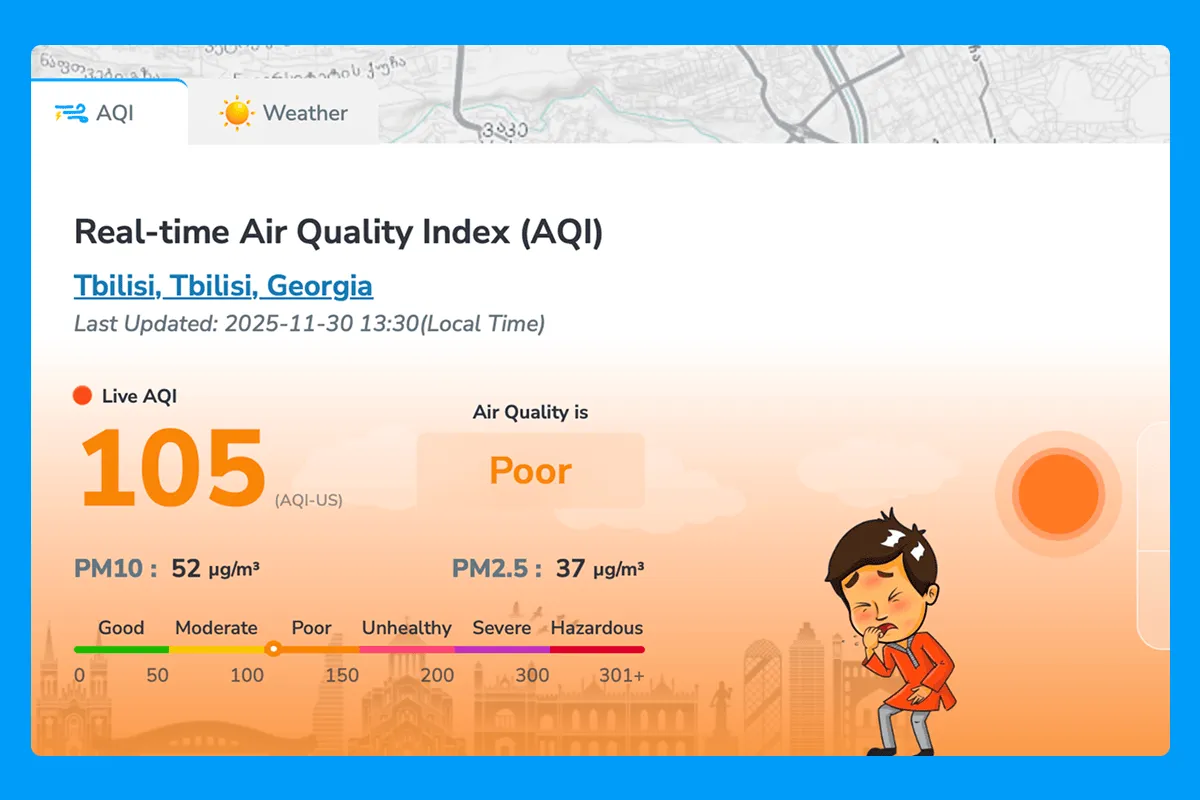
Air quality in Tbilisi on November 30th 2025 on aqi.in showing AQI 105 (Poor), with PM10 at 52 µg/m3 and PM2.5 at 37 µg/m3
I also use AccuWeather as a good replacement for other weather apps. It shows weather, AQI, and allergen pollen levels all in one place, which makes it convenient for checking both air quality and weather conditions together.
Safety rules I follow every day to protect myself from air pollution
There are rules I follow:
- Check AQI level before opening the window or going out
- If quality is bad, I’ll wait until at least it slightly drops to open the window to add some oxygen
- Buy an air purifier and keep it in my room
- If I need to go out and air quality is bad, wear a special mask or at least cover my face with a scarf
- Apartment should be far enough away from the road
- Avoid walking near crowded roads, pick a route with the least polluted air
- Ask taxi drivers to close windows and switch to inner circulation of air inside
- Use eye drops and gel to protect my eyes from dust
My scarf and most of my warm wardrobe came from Tbilisi swaps. Here’s my story and guide to the swap scene.
For future moving, if I can afford it, pick a city with a lower AQI index