The strategic power of questions, from theory to SEO and AI search
A deep understanding of how questions are formed is a critical component of modern content and SEO strategy. Here's the theory, its application to SEO, and the data-driven proof.

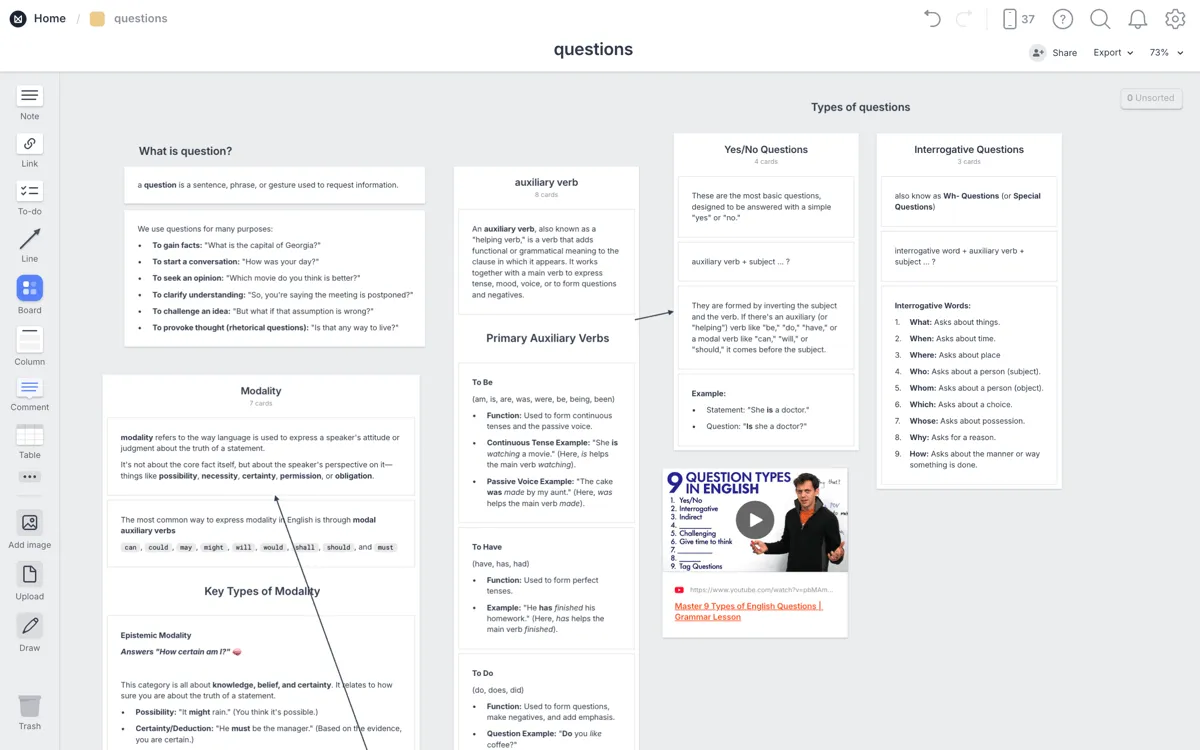
My Milanote research board from the rabbit hole. The starting point for everything in this post.
This is the full research document behind a client project that started with a simple question. A deep understanding of how questions are formed is a critical component of modern content and SEO strategy.
The difference between a “Yes/No” question and an “interrogative” question is the difference between content that is ignored and content that drives traffic, establishes authority, and thrives in the new era of AI search.
This document outlines the theory, its application to SEO, and the data-driven proof of its importance.
The theory of questions, from grammar to intent
At its core, a question is a request for information. For content strategy, understanding a question’s grammatical structure allows us to decode the user’s intent. There are two fundamental categories:
1. Closed questions (Yes/No questions)
These are designed for quick confirmation and can be answered with a simple “yes” or “no.” Their intent is narrow: to validate a fact.
- Structure: They are formed by inverting the subject and a “helping verb.” This verb is either:
- An Auxiliary Verb (is, are, do, does, have), which provides grammatical structure.
- A Modal Verb (can, will, should), which expresses modality (possibility, ability, etc.).
- Examples:
- “Are AI ad audience research tools comparable?”
- “Can AI analyze data?”
- “Does programmatic advertising work?”
2. Open questions (interrogative questions)
These are designed to encourage detailed, explanatory answers. Their intent is broad: to learn, understand, or solve a problem.
- Structure: They begin with an interrogative word (What, Why, How, etc.) followed by an auxiliary or modal verb.
- Examples:
- “What is considered PII?”
- “Why is page speed a ranking factor?”
- “How can you boost an Instagram page?”
The building blocks, understanding modality and intent
The choice of verb in a question reveals the user’s deeper need, a concept known as modality. Modality expresses the speaker’s attitude about possibility, necessity, or ability.
- Epistemic Modality (Certainty & Knowledge): This is the core of informational search. Users are trying to understand what is true or certain. This aligns perfectly with What questions.
- Deontic Modality (Obligation & Permission): Users are asking about rules or best practices. This aligns with Why or Should questions (e.g., “Why should I disavow backlinks?”).
- Dynamic Modality (Ability & Willingness): Users are asking about capability. This aligns perfectly with How questions (e.g., “How can I improve my page speed?”).
This deeper understanding proves why interrogative questions are so powerful. A “Yes/No” question seeks simple validation, while an interrogative question seeks knowledge, instruction, and capability: the very things your content is designed to provide.
Applying question theory to SEO
For SEO, the goal is to align content with user intent. Interrogative questions are vastly superior to Yes/No questions for achieving this.
Why interrogative questions win in SEO
- They Match User Intent: Users searching to learn or solve a problem use interrogative words. A user wanting to learn about Bing Ads searches “Why are Bing Ads effective?”, not “Are Bing Ads effective?”.
- They Have Higher Search Volume: Data consistently shows that “What,” “Why,” and “How” queries have exponentially higher search volumes than their “Yes/No” counterparts.
- They Avoid “Zero-Click Searches”: Google can answer a “Yes/No” question directly in a featured snippet, giving the user no reason to click through to your website. Interrogative questions require a detailed answer that justifies a click.
The funnel-to-question map
We can strategically map interrogative words to the user’s journey, allowing us to create content that meets their needs at every stage.
| Funnel Stage | User’s Goal | Key Interrogative Words |
|---|---|---|
| Top: Awareness | “What is this thing?” | What…? Who…? |
| Middle: Consideration | “Why should I care? How does it work?” | Why…? How…? |
| Bottom: Decision | “Which option is for me?” | Which…? Best…? Vs. |
The impact of AI search (Google AI Overviews)
The rise of AI search engines like Google’s AI Overview, Perplexity, and ChatGPT intensifies the need for interrogative-based content.
An AI search engine acts as a research assistant. When a user asks a simple question, the AI breaks it down into a series of deeper, interrogative questions to build its summary.
- User Query: “Can AI predict market trends?”
- AI’s Internal Questions:
- “What data does AI use to predict trends?”
- “How do AI prediction models work?”
- “What are the limitations of AI forecasting?”
Content structured with clear headings like “How AI Forecasting Works” becomes the perfect raw material for the AI to cite in its answer. A simple “Yes/No” page lacks the substance to be used as a source, rendering it invisible to the future of search.
The proof from GSC data
Theory is good, but data is undeniable. The most powerful argument is to use a site’s own Google Search Console (GSC) data to prove the concept.
Methodology
Each query category was isolated using regex filters applied in GSC and verified in BigQuery. The filters are reusable across any property.
Quick filters for GSC UI
Apply these directly in GSC → Performance → Add filter → Query → Matches regex:
Interrogative questions:
^(what|why|how|who|where|when|which|whose|whom)\bYes/No (closed) questions:
^(is|are|do|does|did|can|will|would|should|could|has|have|was|were)\bComparative/Best questions:
^(best|top|which)\b|\bvs\.?\b|\bversus\b|\bcompared (to|with)\b|\balternative(s)?\b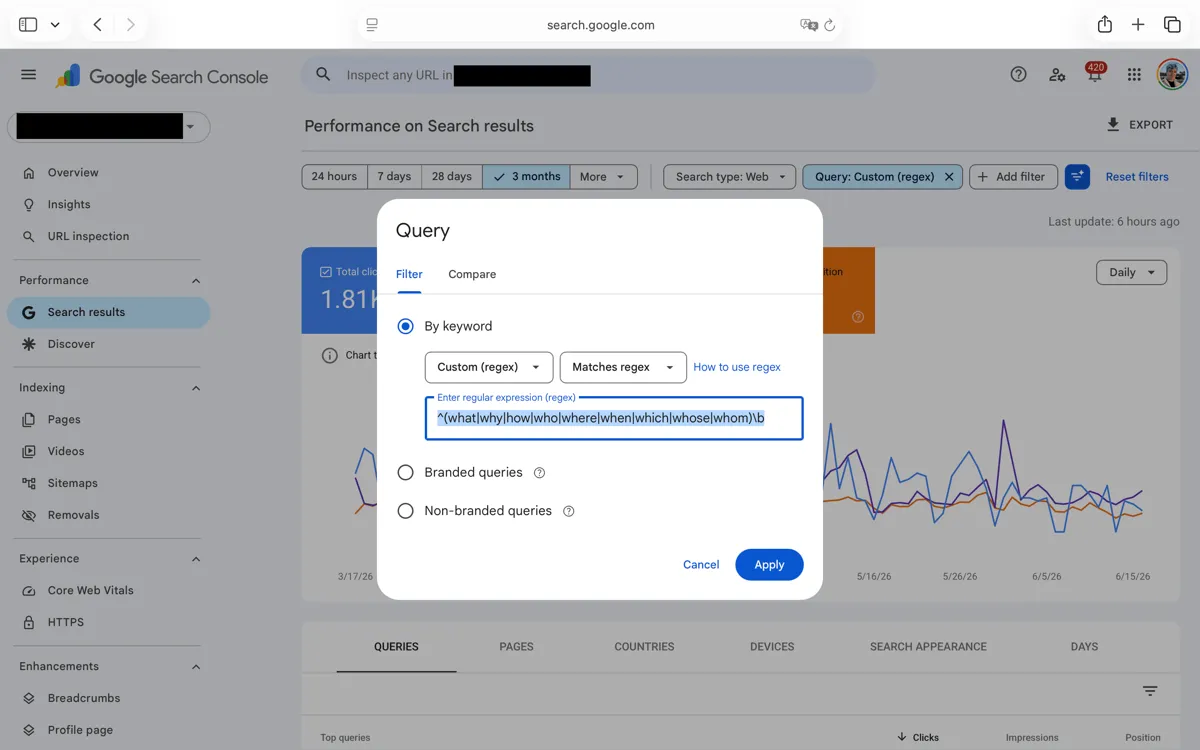
Applying the interrogative regex filter in GSC: Performance → Add filter → Query → Custom (regex) → Matches regex.
BigQuery SQL equivalents
For deeper analysis with aggregated metrics, use REGEXP_CONTAINS in your GSC BigQuery export:
Interrogative:
WHERE REGEXP_CONTAINS(query, r'(?i)^(what|why|how|who|where|when|which|whose|whom)\b')Yes/No:
WHERE REGEXP_CONTAINS(query, r'(?i)^(is|are|do|does|did|can|will|would|should|could|has|have|was|were)\b')Comparative/Best:
WHERE REGEXP_CONTAINS(query, r'(?i)(^(best|top|which)\b|\bvs\.?\b|\bversus\b|\bcompared (to|with)\b|\balternative(s)?\b)')Aggregate all categories in one query:
SELECT
  CASE
    WHEN REGEXP_CONTAINS(query, r'(?i)^(what|why|how|who|where|when|which|whose|whom)\b') THEN 'Interrogative'
    WHEN REGEXP_CONTAINS(query, r'(?i)(^(best|top|which)\b|\bvs\.?\b|\bcompared (to|with)\b|\balternative(s)?\b)') THEN 'Comparative/Best'
    WHEN REGEXP_CONTAINS(query, r'(?i)^(is|are|do|does|did|can|will|would|should|could|has|have|was|were)\b') THEN 'Yes/No'
    ELSE 'Other'
  END AS question_category,
  SUM(impressions) AS total_impressions,
  SUM(clicks) AS total_clicks,
  ROUND(AVG(position), 1) AS avg_position
FROM `your_project.search_console.searchdata_site_impression`
GROUP BY question_category
ORDER BY total_impressions DESCCase study 1
Data collected from GSC over a 3-month period across all query types.
| Question Category | Impressions | Clicks | Avg. Position |
|---|---|---|---|
| Interrogative | 1,580,000 | 1,810 | 8.5 |
| Comparative/Best | 1,370,000 | 855 | 7.0 |
| Yes/No | 101,000 | 194 | 6.9 |
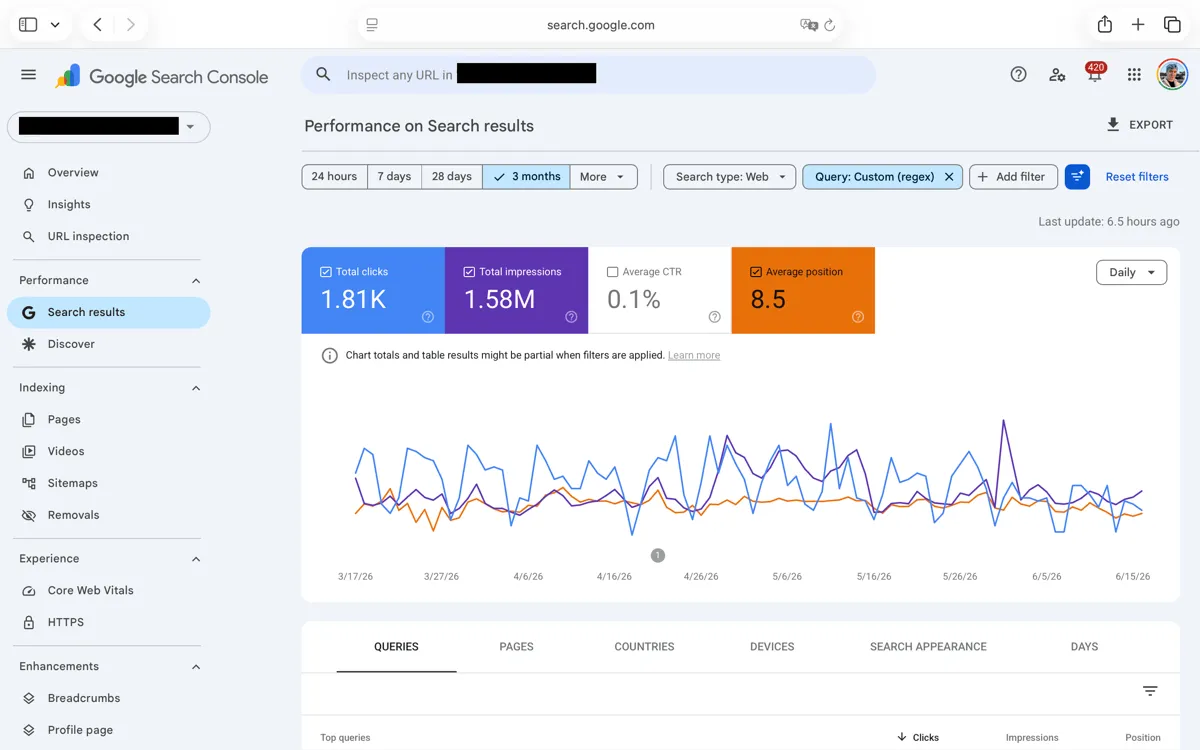
GSC performance for interrogative queries over 3 months: 1.58M impressions, 1.81K clicks, average position 8.5.
Interrogative queries generated 15x more impressions than Yes/No and delivered 9x more clicks. Comparative queries performed similarly to interrogative in volume, confirming that intent-driven formats dominate.
One nuance worth noting: Yes/No queries showed a better average position (6.9) than interrogative (8.5). The higher position for Yes/No reflects that those queries are narrow and often answered by a single authoritative page ranking highly for a very specific fact. The volume gap (101K vs 1.58M impressions) makes clear that higher position on a low-demand query is a much smaller win than lower position on a high-demand one.
Case study 2
To confirm this is not a one-site anomaly, the same methodology was applied to a second, independent site over the same 3-month window.
| Question Category | Impressions | Clicks | Avg. Position |
|---|---|---|---|
| Interrogative | 7,510,000 | 93 | 6.3 |
| Comparative/Best | 14,100 | 1 | 10.4 |
| Yes/No | 2,000 | 1 | 12.9 |
The impression gap here is even more dramatic: interrogative queries outperformed Yes/No by ~3,755x. The ranking pattern also holds: interrogative content ranked at position 6.3 vs. 12.9 for Yes/No, nearly 2x better. Comparative queries sat in between on position (10.4) but with negligible volume, suggesting this site has an untapped opportunity in comparison content.
Again, the position nuance applies: Yes/No queries tend to rank well because they are narrow and low-competition. But ranking 12th for a query with 2K impressions is structurally less valuable than ranking 6th for one with 7.5M.
Key takeaway across both cases: Interrogative content attracts more searches and earns better rankings on queries that actually matter at scale. Strong positioning on high-volume interrogative demand matters far more than a top position on a thin Yes/No query. This is a structural SEO advantage, replicated independently across two sites.
Conclusion and next steps
To succeed in modern search, content must evolve from providing simple validation (Yes/No) to offering comprehensive explanations (What, Why, How).
The proven, scalable strategy is as follows:
- Prioritize: Use GSC data with the regex filters above to identify Yes/No questions that have some existing user interest: these are your highest-leverage rewrite targets.
- Automate transformation: Use a tool, such as a Google Sheets script with the Gemini API, to rewrite these questions and their corresponding answers into an interrogative format and classify their funnel stage.
- Implement strategically: Map these new, intent-driven questions to the most relevant articles on your site and structure the content to guide the user logically through their journey from awareness to decision.